
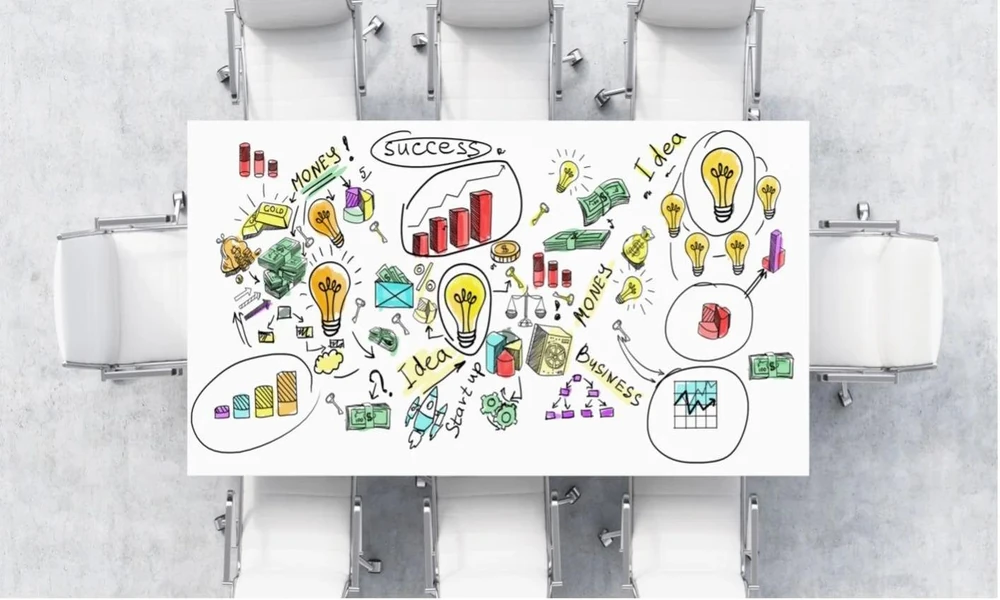
Important meetings often generate a surprising amount of information.
A strategy workshop might involve competing priorities, customer insights, proposed initiatives, risks, and dozens of ideas. A planning session may produce pages of notes but still leave participants uncertain about what was actually decided.
Graphic facilitation offers a different approach: make the conversation visible while it is happening.
Rather than recording discussions solely as paragraphs of meeting notes, a graphic facilitator uses words, diagrams, symbols, relationships, and visual structures to capture the key elements of a conversation.
Why Visual Capture Can Change A Meeting
Traditional meeting notes tend to follow a linear format.
One person speaks, followed by another, followed by another. Important relationships between ideas can become difficult to see.
Visual capture works differently.
Ideas can be grouped together. Related concepts can be connected. Contradictions can be displayed. Decisions can be separated from open questions. Priorities can be arranged according to importance or timing.
Participants can then see the structure of the discussion rather than remembering it as a sequence of statements.
Graphic Facilitation Is Not Just Drawing
A common misconception is that graphic facilitation is primarily about artistic ability.
Drawing skill can certainly help, but the more important capability is active listening and information synthesis.
The facilitator needs to determine which statements represent major themes, decisions, questions, examples, or supporting details.
A visually attractive board that captures the wrong information is not useful.
The best graphic facilitators therefore combine communication skills with visual thinking.
Useful In Strategic Planning
Strategic planning sessions are particularly suitable for graphic facilitation because they often involve interconnected ideas.
A facilitator might visually organize a discussion into:
Current situation → challenges → opportunities → strategic choices → actions
As the group discusses each area, information can be added to the appropriate section.
This can prevent conversations from becoming circular because participants can see what has already been established.
Helping Teams See Disagreements
Visual facilitation can also expose differences in perspective.
Imagine a team discussing the reason for declining customer retention. One group believes the problem is pricing, another believes it is customer service, and another believes the product itself needs improvement.
Writing all three opinions in a conventional meeting summary may hide the disagreement.
Displaying the competing hypotheses side by side makes the difference explicit.
The team can then decide what evidence is needed to determine which explanation is strongest.
Creating A Shared Reference Point
After a workshop ends, participants often remember different aspects of the conversation.
A visual summary can provide a shared reference point.
Instead of asking, “What did we decide last week?” participants can return to the visual record and identify agreed priorities, unresolved questions, responsibilities, and next steps.
This can be especially valuable for workshops involving multiple departments or stakeholders who do not normally work together.
Digital And In-Person Applications
Graphic facilitation is not limited to someone standing beside a physical whiteboard.
The same principles can be applied using digital collaboration platforms, tablets, large displays, and virtual meeting environments.
The medium can change, but the objective remains the same: transform a complicated discussion into a visual representation that people can understand.
Digital formats can also make it easier to distribute the final visual summary to participants after the session.
When To Use Graphic Facilitation
Graphic facilitation can be particularly useful for:
• Strategic planning sessions
• Team workshops
• Innovation meetings
• Organizational change programs
• Stakeholder consultations
• Training sessions
• Project kickoffs
• Retrospectives
• Community discussions
It is most valuable when a meeting involves substantial discussion, multiple perspectives, or complex relationships between ideas.
From Meeting Notes To Shared Understanding
The biggest benefit of graphic facilitation is not the artwork produced at the end of a meeting.
It is the shared understanding created during the process.
When people can see their ideas being connected, organized, challenged, and refined in real time, the conversation becomes easier to follow. Participants can identify gaps, clarify misunderstandings, and recognize decisions as they emerge.
For organizations that regularly spend hours in workshops and planning sessions, making those conversations visible can turn meetings from temporary discussions into useful, reusable knowledge.